- Home
- Denver
Bail bonds in Denver, Colorado
Denver does bail differently than the rest of the state. Here’s what that actually means at two in the morning, in plain words, from someone who has been doing this since 1997.
Who answers, and what happens first.
I’m Dave Wood. I’m a licensed Colorado bail agent and I have been writing bonds since 1997. I’m based in Colorado Springs and I write bonds statewide, Denver included. I don’t have a storefront on Colfax and I’m not going to pretend I do. What you get is one licensed Colorado agent, on the phone, at any hour.
When you call, the first thing I do is figure out where the person actually is and whether they can be bonded yet. That second part matters more than people expect. In Denver, as everywhere in Colorado, a bond cannot be posted until the person is fully booked and their fingerprints have cleared. Until that happens, nobody can move — not me, not you, not the fastest agent in the state. If someone tells you otherwise tonight, they are guessing.
While that runs, we do the paperwork. Almost all of it happens by phone and online: the application, the indemnity agreement, and the payment. You do not need to drive downtown to meet me, and you do not need to find the jail before you find me. The co‑signer can be in Denver, in Grand Junction, or in another state entirely.
Before you dial, write down whatever you already know: the person’s full legal name, their date of birth, roughly when and where they were picked up, and the booking number and bond amount if anyone has told you those. If all you have is a name, call anyway. A name is enough to start, and the rest gets filled in while we talk.
The premium is a one‑time fee. Colorado bail rates are filed with the state, and I’ll quote you your exact number on the call, before you sign anything. I won’t promise you a release time, either — the jail controls that, not me. What I will do is tell you the truth about the sequence and stay reachable until it’s finished.
Someone sitting in a cell right now? Don’t read the rest of this. Call (719) 499-7787 and I’ll start the lookup while we’re talking.
Rates are filed with the state — exact quote on the call, before you sign
Denver has two jails. Downtown is the one that matters.
This is the single most useful thing on this page, so I’ll put it first: everybody arrested in Denver gets processed downtown, and downtown is where a bond gets posted.
The building you want is the Downtown Detention Center at 490 W. Colfax Ave. You will also see it called the Van Cise‑Simonet Detention Center — that is the same building, not a second one. The county’s number for that facility is 720‑337‑0400. That is the county’s line, not mine; my number is the one at the top of this page.
Note the West in West Colfax. Colfax runs a long way in both directions, and an east address is a completely different part of the city. It is worth reading the address back to whoever is driving before they pull out of the driveway.
Denver’s Sheriff runs a second facility as well, the Denver County Jail at 10500 E. Smith Rd (county number 720‑913‑3642), several miles northeast of downtown. People get moved between the two, and I’m not going to tell you a tidy story about which building holds which kind of detainee, because the tidy stories you’ll read elsewhere aren’t reliable. Here is what is reliable: all detainees are processed downtown, and the bonding office sits in the Downtown Detention Center lobby. That is the address that matters when it’s time to post.
Before anything can be posted, booking has to finish and fingerprints have to clear. That step is not negotiable and it is not something a bondsman can hurry along. It is also the reason two arrests on the same night can take very different amounts of time — the number of people going through booking ahead of you is the variable nobody controls.
To confirm someone is in custody, the county runs its own lookup at denvergov.org/InmateSearch. Records can lag behind reality by a while, especially right after an arrest, so an empty result at 1 a.m. does not always mean what you think it means. My inmate search guide covers how to read that, and honestly, calling me is usually faster than refreshing a page.
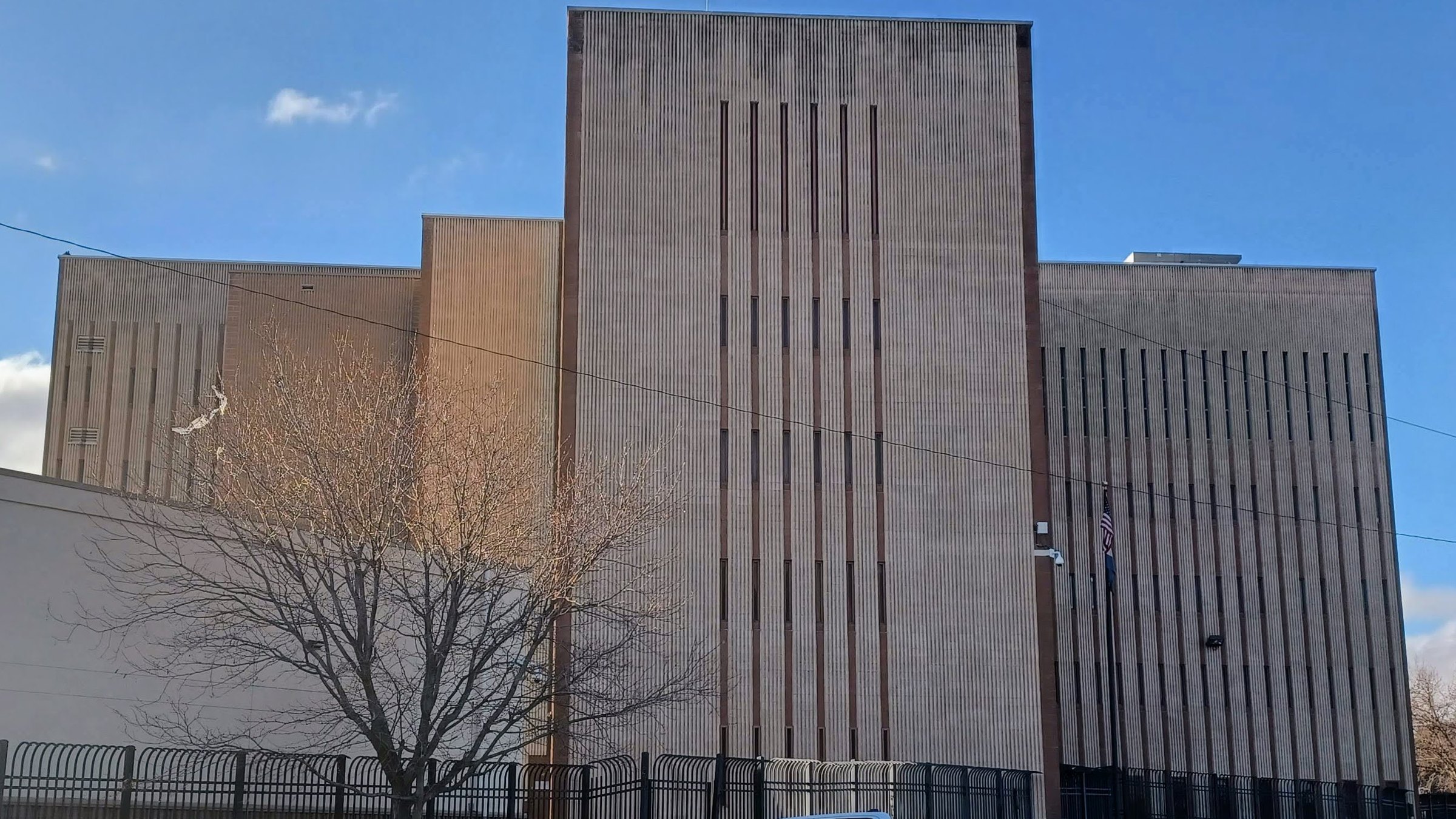
The courthouse is across the block from the jail.
Denver is unusual in Colorado this way. In most counties the jail and the criminal courthouse are miles apart. Here they are practically across the street.
Criminal cases in Denver are heard at the Lindsey‑Flanigan Courthouse, 520 W. Colfax Ave. Both Denver District Court — the 2nd Judicial District — and the criminal division of Denver County Court sit in that building. The jail is at 490 W. Colfax. Same block, essentially facing each other. Say it out loud to whoever is driving, because it saves a trip: one address covers both ends of this.
Now the part that makes Denver genuinely different from every other county I write in. In Denver, the Sheriff does not run the bonding office. Denver County Court does, out of the detention center lobby. That is not a quirk of staffing; it comes from how the city is built. Denver is a consolidated city and county with four constitutionally separate courts, and its County Court is city‑operated rather than part of the state court system. Everywhere else in Colorado, the county sheriff’s people handle the bond window. In Denver, it’s the court’s.
For you, the practical effect is simply that the process has its own rhythm and its own paperwork, and that being told something different by a friend who bonded someone out in another county doesn’t mean anyone is lying to you. It means Denver is Denver. I’ve worked it long enough not to be surprised by it.
One warning worth more than anything else on this page. Do not send anyone to the Denver City & County Building at 1437 Bannock St for a criminal matter. That building handles civil and domestic business. Families end up there because it is the building everyone pictures when they think “Denver courthouse,” and it costs them an hour they cannot spare. Criminal means Colfax.
Once someone is out, the court dates are the whole job. Missing one means a warrant and a revoked bond, and the premium you paid does not come back. Put every date on a calendar the day you receive it, and keep whatever paperwork the jail hands over at release — the conditions and the first appearance are in that stack.
| What you need | Where it happens in Denver |
|---|---|
| Booking, custody, and posting a bond | Downtown Detention Center (Van Cise‑Simonet), 490 W. Colfax Ave — bonding office in the lobby, run by Denver County Court |
| Criminal court dates | Lindsey‑Flanigan Courthouse, 520 W. Colfax Ave — Denver District Court and Denver County Court’s criminal division |
| The second sheriff facility | Denver County Jail, 10500 E. Smith Rd — several miles northeast; everyone is still processed downtown |
| Civil and domestic matters | Denver City & County Building, 1437 Bannock St — not where a criminal case is heard |
Every bond type, written from anywhere in the state.
The charge changes the paperwork and the timing. It doesn’t change whether I can help.
Most calls are misdemeanor bonds — smaller amounts, simpler files — or felony bonds, where the numbers run higher, collateral sometimes enters the conversation, and I walk you through each line before you agree to it. DUI bonds are steady work in a city this size, and they almost always come at an ugly hour.
Domestic violence bonds follow their own rules in Colorado, including timing that catches families off guard, so read that page before you assume anything about tonight. I also write drug charge bonds, from simple possession up, and warrant and failure‑to‑appear bonds, including walk‑through turn‑ins arranged in advance so nobody gets picked up at work or at a traffic stop.
It helps to know what the court actually set. Colorado bonds come in four forms. Personal recognizance means a signature and a promise to appear, with no money up front. Cash means the court holds the full amount until the case ends. Property pledges real estate to the court. Surety is the kind I write: you pay a fraction, and I stand behind the full amount with the court.
On larger felony bonds, collateral sometimes backs the agreement — a vehicle title, real estate, something with real value. Collateral is held, never spent. It sits as security while the case moves and it comes back when the court exonerates the bond at the end, whatever the outcome of the case turns out to be.
If all of this is new, start with how bail bonds work in Colorado, which puts the whole sequence in order from arrest to exoneration. Services lists everything I write. And when you’re ready, the online bond application asks for the same information I’d ask for out loud — useful if typing is easier than talking right now.
No money up front — the court releases on the person’s word to appear
The full amount goes to the court and sits there until the case ends
Slower to arrange, and rarely the right tool at two in the morning
You pay a fraction; I answer to the court for the whole amount
Questions Denver families ask.
Q.01Which Denver jail is he in?
Start with downtown. All detainees are processed at the Downtown Detention Center at 490 W. Colfax Ave, also called the Van Cise‑Simonet Detention Center. Denver’s Sheriff also runs the Denver County Jail at 10500 E. Smith Rd, several miles northeast, and people do get moved. I won’t guess which building someone is in tonight — I’ll confirm it. The county lookup at denvergov.org/InmateSearch is the official source, and the county number for the downtown facility is 720‑337‑0400.
Q.02Why can’t we post bond yet?
Because booking isn’t finished. A bond cannot be posted in Denver until the person is fully booked and their fingerprints have cleared. That is a hard requirement, and no bondsman can shortcut it. It is also why the wait varies so much from one night to the next — how many people are ahead of you in booking is the part nobody controls. The useful thing you can do in the meantime is get the paperwork done with me, so that when the system says yes, nothing is waiting on us.
Q.03Do you have an office in Denver?
No, and I’d rather say so plainly than let you find out later. I’m based in Colorado Springs and licensed to write bonds statewide, Denver included. I either drive up or arrange it — what you’re hiring is one licensed Colorado agent who answers his own phone at any hour, not a chain with a lobby on Colfax. Nearly everything you need to do happens by phone anyway, and the co‑signer can be anywhere in the country while we do it.
Q.04Is the courthouse the same place as the jail?
Not the same building, but the same block. The jail is at 490 W. Colfax Ave and the Lindsey‑Flanigan Courthouse, where criminal cases are heard, is at 520 W. Colfax Ave — essentially across from each other. Denver District Court and Denver County Court’s criminal division are both in that courthouse. What you want to avoid is the Denver City & County Building at 1437 Bannock St; that’s civil and domestic business, not a criminal case.
Related reading
Where you go next depends on what you still don’t know. If you’re not yet certain the person is in custody, or the county lookup came back empty and you don’t know how to read that, the inmate search guide is the right page. Records lag, names get entered oddly, and an empty result at 1 a.m. is not the same as an answer.
If you’ve never done any of this before, how bail bonds work in Colorado lays out the whole sequence in order: the arrest, the booking, how a bond amount gets set, what the premium buys, what indemnity means, and the day the court exonerates the bond and the file closes. It is the page I’d hand someone who has an hour and wants to actually understand what they’re signing.
The FAQ handles the questions that come up once the first wave of panic passes — who can co‑sign, what happens if a court date gets missed, what the co‑signer is actually on the hook for, and how collateral comes back. Those are the questions people call me about at noon the next day, and the answers are all written down there.
When you’re ready to move, the online bond application collects the defendant and co‑signer details I’d otherwise ask for out loud. Plenty of people find it easier to type at three in the morning than to talk, and it means the call afterward is short.
And if the arrest turns out not to have been in Denver at all, that happens more often than you’d think when someone is calling from a different city. Bail bonds in Colorado Springs covers my home ground down south. Either way, the number is the same at any hour: (719) 499-7787. If you’d rather skip every page on this site and just ask a person, that is a completely reasonable thing to do tonight.

Denver bonded, Denver explained —
by someone who answers the phone.
One licensed Colorado agent, on the phone, at any hour. Call and we’ll start the lookup while we talk.
Colorado Springs · Denver · Statewide · On call 24/7